a short essay about a donkey
The following is a modified excerpt from my application to the Guggenheim Fellowship.
(I didn’t get it.)
A STORY
Once upon a time, a man was crossing the street when he was suddenly hit by an oncoming truck. Afterwards, he cried out, “Finally, something happened!”
✾✾✾
I’m interested in this moment that wakes us up. What is the truck? It could be an infinite number of events. A colossal failure when one is so confident that they would succeed. The psychedelic, overwhelming grief of a beloved’s death. Falling in love, a broken heart.
And then, suddenly, here we are: in this liminal, terribly fallible, and profoundly human place to find ourselves. It’s often embarrassing, taboo, usually feared and avoided at all costs. A wise woman once told me that divinity dwells here, in this place of shadow. This sphere is so often just out of reach of our conscious understanding and control. It’s a place of darkness and mystery. From the darkness, the resulting contrast of life reflects so brightly back that it’s like staring into the sun.
✾✾✾
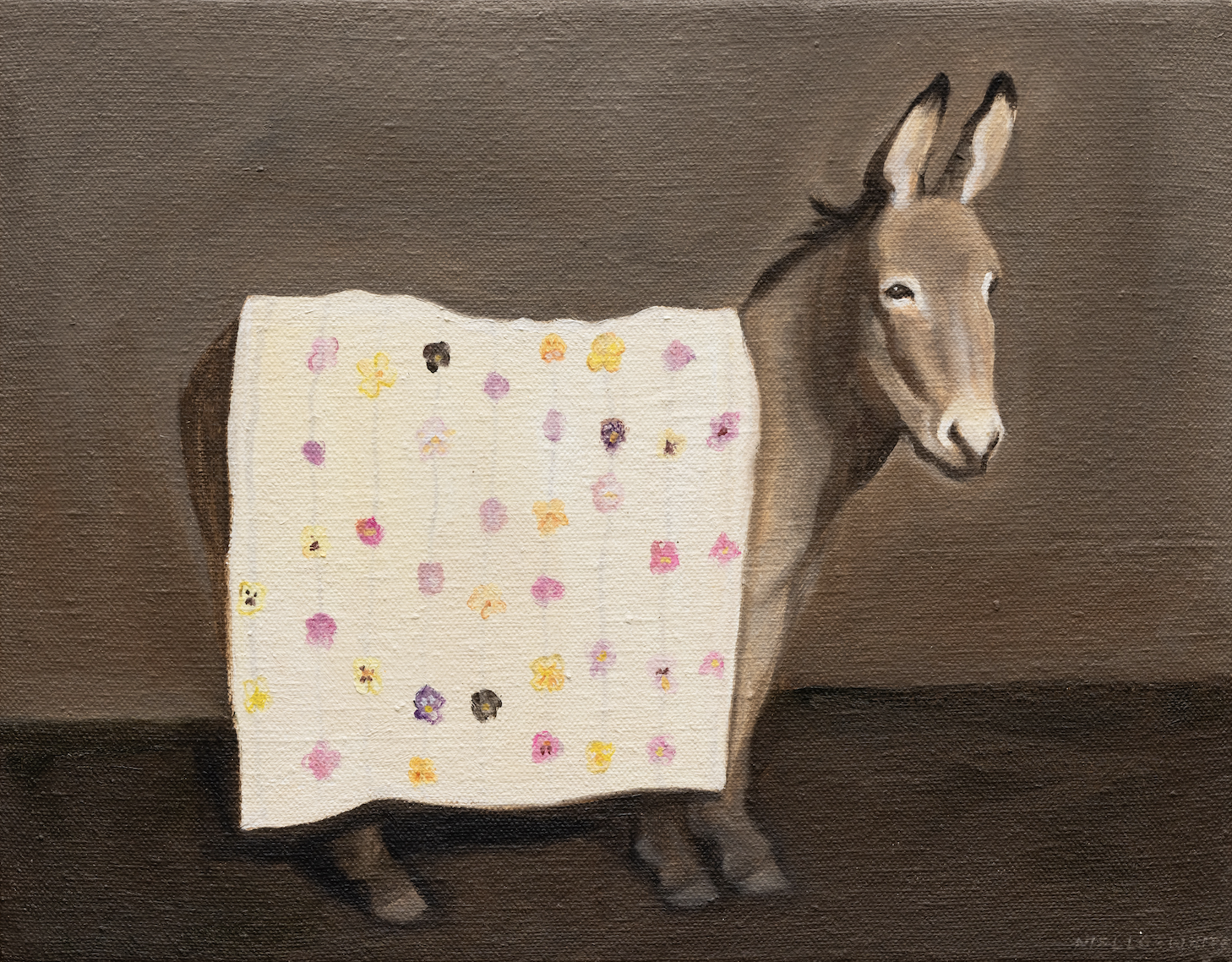
I made a painting of a donkey with William Shakespeare’s play A Midsummer Night’s Dream in mind. The donkey is standing with a tapestry woven with wild pansies flung over its torso like a saddle blanket — the wild pansy being the main ingredient of the love potion Oberon puts on Titania’s eyes while she sleeps. The intention of his prank is that she “wake when some vile thing is near.” And lo: a man with the head of a donkey. When Titania wakes, she instantly falls in love with him, and he accepts all of this as natural, introducing himself to her horrified handmaiden fairies.
Back to the donkey in the painting. This animal is inherently hilarious: the too-long, stiff, bristly ears; the stout body; the brooding, elongated snout. At the same time, this creature has dignity; he doesn’t know that he looks absurd. These animals tend to read as taciturn and grumpy, like Eeyore in Winnie-the-Pooh. My son and I laugh every time we see one. Finally, a moment of mercy, of relief — this act of laughing together. I can laugh at my own folly, my own mistakes, my own ill-suited desires.
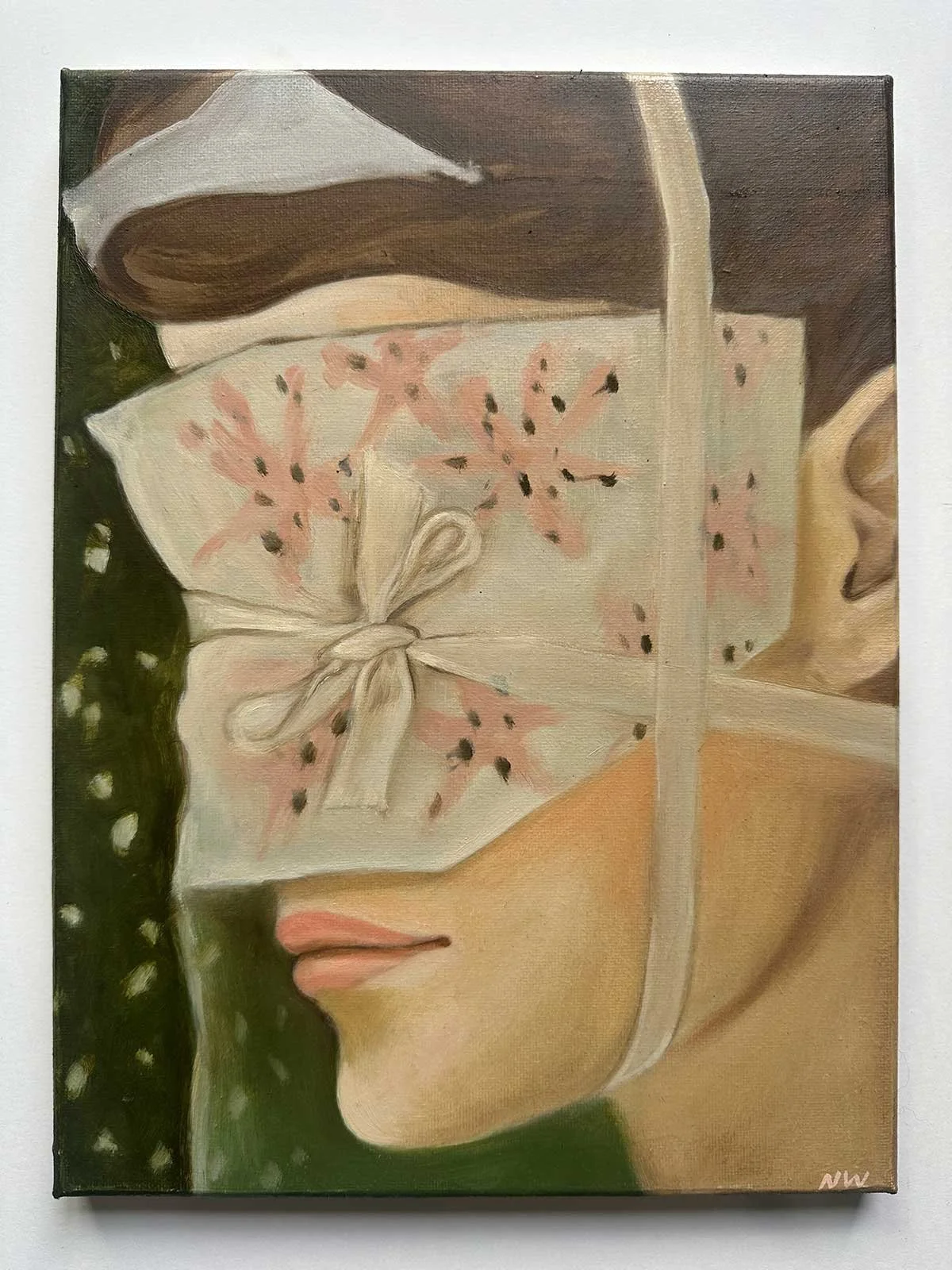
I made another painting later without thinking too much about it. It’s basically the same, but the pansies have moved. A woman stands with her eyes covered by a cloth, tied tightly over her eyes. But here, the enchantment is no longer draped; it’s bound.
And yet her mouth is soft, she’s surrendered to her state of not knowing, not being in control.
The scene when Titania falls for the donkey-headed man is so cringey and tender and hilarious, it may be one of my all-time favorite things to watch. It’s a delight to witness human — and in this case, a goddess’s — folly. Arthur Schopenhauer wrote: “Man does at all times only what he wills, and yet he does this necessarily. But this is because he already is what he wills.” We can do what we want, but we cannot control what we want, and so we are not free. We mortals have strange desires and make terrible choices and are therefore steeped in suffering. Art and storytelling like this offer a moment of relief or consolation for our condition — a chance to step back and laugh at ourselves. I’ve played the role of Titania, and I’ve also been the oblivious, ass-headed man. Life is a play, and we are all characters.